Inside the Build: Automated Quote Follow-Up That Never Forgets
Quotes were sent the same day for a home services contractor, but the follow-up sequence only existed in the owner's head, so busy weeks meant sent quotes were never chased. Here is how automated quote follow-up fixed that.
Does this sound like your business?
Here is how automated quote follow-up works for a home services contractor who sent quotes out fast, the same day, every time, but had no system for what happened after. The follow-up sequence lived entirely in the owner’s head, which meant a quiet week got chased properly and a busy week meant sent quotes just sat there, un-followed-up, with no view of which jobs were even still open.
This is one of the case studies on the case studies page. What follow-up looked like before, what got built, and why every touch gets logged.
Why a Fast Quote Isn’t the Same as a Won Job
Sending a quote quickly is table stakes, most competitors can do that too. The businesses that actually win the job are usually the ones that follow up consistently afterward, and consistency is exactly the thing that breaks down first when someone is busy, because chasing a sent quote has no natural trigger the way answering an incoming call does. Nobody forgets to answer the phone. It is easy to forget to check on a quote from ten days ago. Research on how fast a lead’s value decays makes the same point from the other direction: the businesses that respond and follow up fastest are the ones that convert best, and that edge erodes with every day a quote sits unchased.
How the Automated Quote Follow-Up Sequence Actually Runs
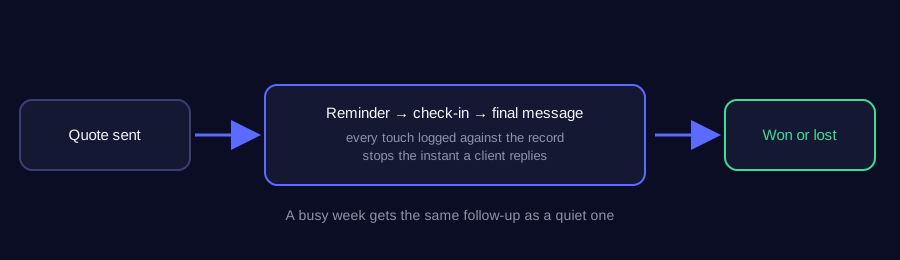
The moment a quote goes out, a sequence starts on its own: a reminder, then a check-in, then a final message, spaced out rather than fired all at once. Every one of those touches is logged directly against the quote record, so anyone can see exactly what has already been sent without having to ask. The sequence stops immediately the moment the client replies, or the job gets marked won or lost, so nobody ever gets an awkward follow-up for a decision that has already been made.
Why the Pipeline View Mattered as Much as the Messages
Automating the messages solved half the problem. The other half was visibility: before this, there was no single place to see which quotes were still genuinely open. Once every quote’s status lives in one record instead of the owner’s memory, the pipeline itself becomes something anyone on the team can check, not just the person who happened to send the quote.
The Same Pattern Behind Getting Paid, Not Just Getting the Job
A follow-up sequence that escalates in tone, checks its own trigger before firing, and stops the moment the real-world status changes is the same underlying pattern used to automate invoice follow-ups once a job is actually won and billed. Quote follow-up gets the work in the door; invoice follow-up gets it paid. Neither should depend on one person’s memory holding up during a busy week.
What Changed Once Nobody Had to Remember
The clearest result was not a specific number, it was the disappearance of a specific kind of quiet loss: a quote that was genuinely winnable, that nobody actively decided to drop, but that simply never got chased because the week got busy. Follow-up now happens the same way every time, regardless of how the week is going.
Why the Escalating Tone Was a Deliberate Choice
The three messages in the sequence are not the same message sent three times. A friendly reminder, a genuine check-in, and a final message that reads differently from the first two, each one is written for where the client is likely to be in their decision, rather than repeating the same nudge and hoping persistence alone does the work. A quote follow-up sequence that feels the same on the third touch as the first reads as a robot pestering someone, which is worse for the relationship than not following up at all.
Does this sound like your business?