Inside the Build: An AI Legal Intake Widget in 5 Languages
A German law firm's website could only take in new-client enquiries in German. Here is how we built an AI legal intake widget that handles the same conversation in five languages, and why the lawyer still makes every decision the software never should.
Does this sound like your business?
Here is how we built an AI legal intake widget for a law firm whose website could only take in new-client enquiries in German. Anyone reaching out in another language got a slower, thinner response, if they got one at all, since every enquiry still had to be read, judged, and replied to by hand before a single consultation happened.
This is the story behind one of the case studies on the case studies page. What the intake process looked like before, what got built, and why the AI never makes the one decision that actually matters.
Why One Language Wasn’t Enough
A law firm’s new-client intake is usually the first real interaction someone has with the firm, and it is often the moment they are most anxious and least equipped to explain their situation clearly, especially in a second language. A firm that only intakes in German is not turning away people who do not need a lawyer. It is turning away, or badly serving, people who need one and cannot describe their case well enough in a language that is not their own.
How the AI Legal Intake Widget Actually Works
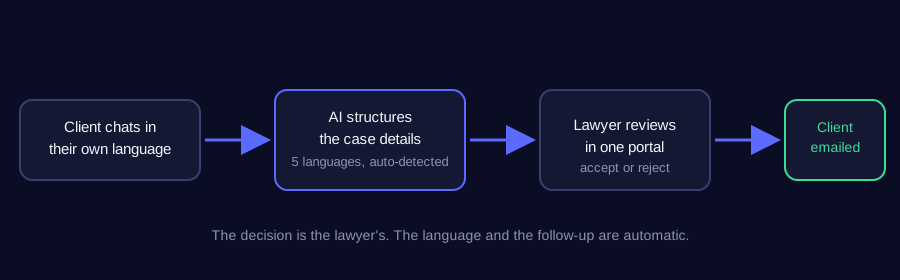
A chat widget embeds directly on the firm’s own website, detects the language of the client’s very first message, and carries the entire conversation in German, English, Turkish, Arabic or Russian from there. It walks through a structured intake, the same core questions a lawyer would ask in the first five minutes, and lets the client attach documents along the way. Once the conversation is complete, the case is submitted with everything extracted and organised: the facts, the documents, the language it was conducted in.
Why a Lawyer Still Makes Every Decision
The AI never decides whether to take a case. Every submitted case lands in a password-protected portal where a real lawyer reads it and makes one call: accept or reject. That single decision is what actually matters legally and professionally, and it stays entirely human. What the automation removes is everything around that decision: retyping the client’s details, translating a reply by hand, remembering to send a confirmation. The moment the lawyer decides, the client gets an automatic email in the language they used from the start, without anyone drafting it.
What Makes This Different From a Generic Chatbot
A generic support chatbot answers questions. This is closer to a structured form that happens to feel like a conversation, built specifically around what a legal intake actually needs to capture, and grounded in Azure OpenAI’s GPT-4o for the conversational layer rather than a rigid multi-page form nobody enjoys filling in under stress. The same pattern of separating what software should decide from what a professional should decide is the same one behind automating a rental contract for a different legal client: the software handles the paperwork and the language, the professional handles the judgement call.
Why This Approach Scales to More Than One Firm
The whole system is built so a second law firm can be added without touching any code: one configuration file sets the firm’s branding, which languages are enabled, and which lawyer’s inbox gets the case notifications. The conversation logic, the portal, and the email templates are all shared. That is a deliberate design choice, not an accident, since a legal intake tool that only works for one firm is a much smaller thing to have built than one that can onboard the next firm in an afternoon. Everything specific to a firm, the branding colour, which languages are turned on, whose inbox gets the notifications, lives in that one file and nowhere else, so extending this to a second firm is genuinely a configuration change, not a rebuild.
Does this sound like your business?