Retell AI vs Vapi vs Bland AI: Which AI Voice Platform Should You Build On?
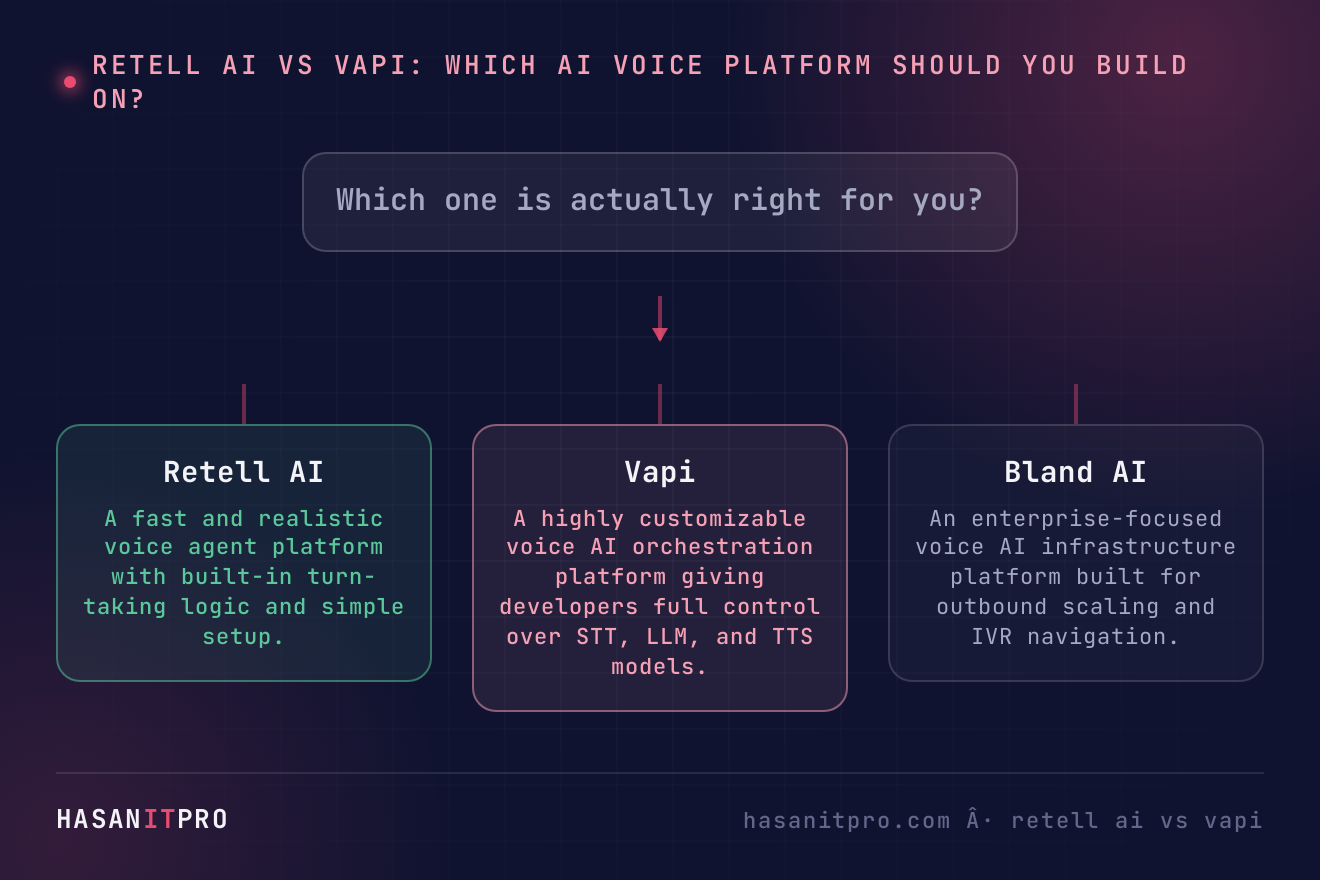
Choose Retell AI if you need quick setup with natural human turn-taking out of the box. Pick Vapi if you want full modular control over your STT, LLM, and TTS stack with client SDKs. Opt for Bland AI if you are running massive enterprise outbound phone campaigns or navigating IVR systems.
Does this sound like your business?
Building automated conversational voice agents used to require stitching together separate WebRTC servers, Speech-to-Text models, LLMs, and Text-to-Speech engines. Today, platforms like Retell AI, Vapi, and Bland AI handle the real-time audio pipeline for you. When evaluating retell ai vs vapi for your next voice agent project, picking the right backend architecture is critical. Both platforms offer low latency and custom LLM integrations, but they target slightly different developer workflows. In this guide, we will break down the features, pricing, and performance of Retell AI, Vapi, and Bland AI so you can build with confidence.
Retell AI vs Vapi: Latency and Speech Quality
Voice applications live or die based on latency. If a human speaks and the agent takes two seconds to respond, the conversation feels unnatural and frustrating. Both Retell AI and Vapi optimize the media pipeline by piping audio streams directly between user devices and speech models.
Retell AI focuses heavily on realistic conversational pacing. It provides built-in turn-taking logic that detects when a user pauses or finishes speaking, which prevents the bot from cutting off human speakers prematurely. We built a real, live voice agent on Retell AI for a multi-location service business, and callers genuinely do not notice a delay in the response, which matters more in practice than any published benchmark number.
Vapi takes a modular approach. It gives developers total freedom to swap out underlying STT providers (like Deepgram or Whisper), LLMs (OpenAI, Anthropic, or Groq), and TTS models (ElevenLabs, PlayHT, or Cartesia). According to Vapi official documentation, users can fine-tune turn detection and noise cancellation settings per call. If latency is your primary concern, Vapi lets you route calls through the fastest provider in your target region.
Developer Experience and Webhook Architecture
Integrating voice agents into your existing CRM or workflow builder requires reliable webhooks and custom tool calling.
Retell AI provides a streamlined dashboard and SDKs for Node.js and Python. You can configure custom LLM endpoints effortlessly. If you want your agent to query a database mid-call or check calendar availability, Retell passes function calls to your server and waits for the payload. If you are comparing an AI voice agent vs answering service, having reliable custom function calls is what turns a basic receptionist into an actionable sales tool.
Vapi offers a more API-first developer workflow. It supports server URL webhooks, client-side SDKs for Flutter, Web, React Native, and Swift, and granular call event logs. You can listen to real-time events like speech start, function calls, and call disconnects. In the retell ai vs vapi comparison, developer control over conversation orchestration remains a central factor. Vapi gives you raw control, whereas Retell simplifies the setup process.
Bland AI: The Alternative for Enterprise Inbound and Outbound
While Retell AI and Vapi act as orchestration layers over modular AI providers, Bland AI approaches voice from an end-to-end perspective. Bland built proprietary infrastructure designed specifically for high-volume outbound calls and automated phone trees.
Bland AI excels at complex phone-system tasks like navigating IVR trees, transferring calls to human agents, and handling enterprise outbound campaigns. However, it offers less modularity than Vapi or Retell. If you want to bring your own specialized fine-tuned LLM or custom text-to-speech engine, Bland AI can feel more restrictive.
Pricing and Cost Structure
Cost is another important consideration. Voice agent pricing typically combines platform fees with underlying model usage (STT + LLM + TTS + Telephony).
Retell AI charges a flat platform rate per minute, which includes native turn-taking models and streaming orchestration. You pay separately for telephony costs (Twilio or native numbers) and LLM token usage.
Vapi’s pricing unbundles the platform fee from the underlying provider costs, so your total cost depends on which STT, LLM, and TTS providers you choose to plug in. This can work out cheaper if you optimize for lower-cost providers, but unlike Retell’s flat platform rate, the total is not fixed.
Bland AI also prices per minute, with volume-based discounts available for high-volume enterprise callers, which fits its focus on large-scale outbound campaigns.
Which AI Voice Platform Should You Actually Build On?
Choosing between these three platforms comes down to your technical requirements and operational priorities:
Choose Retell AI if you want a polished out-of-the-box experience with natural turn-taking logic, fast setup times, and minimal friction. It is ideal for agency owners and developers building voice receptionists or scheduling agents.
Choose Vapi if you want maximum developer flexibility, custom client-side SDKs, and total control over every component in your voice stack. It is best suited for engineering teams building complex custom voice software.
Choose Bland AI if your primary focus is large-scale outbound phone operations, enterprise call center routing, or automated phone tree navigation.
Retell AI
A fast and realistic voice agent platform with built-in turn-taking logic and simple setup.
- Fast enough in real use that callers do not notice a delay, confirmed on a live deployment
- Built-in human-like pause detection
- Easy integration with custom LLM endpoints
- Slightly less provider flexibility than Vapi
- Platform fees attached to total usage
Vapi
A highly customizable voice AI orchestration platform giving developers full control over STT, LLM, and TTS models.
- Complete modularity across STT, LLM, TTS, and telephony
- Robust client SDKs for Web, Mobile, and Flutter
- Unbundled pricing lets you optimize cost by choosing your own providers
- Requires more manual setup and configuration
- More complex stack management for non-developers
Bland AI
An enterprise-focused voice AI infrastructure platform built for outbound scaling and IVR navigation.
- Optimized for large-scale outbound calling campaigns
- Built-in tools for navigating phone trees
- Competitive high-volume pricing
- Less provider modularity than Retell or Vapi
- Harder to bring custom external voice engines
Does this sound like your business?