Inside the Build: AI-Drafted Replies for Repeat Support Questions
Product and licensing questions arrived by email, chat and a help desk, and each agent answered from their own notes, so replies varied and new hires took weeks to get accurate. Here is how AI-drafted replies fixed that.
Does this sound like your business?
Here is the story behind AI-drafted replies built for a B2B software reseller whose support team answered the same product and licensing questions from memory, across three separate channels. Every agent had their own notes, so two people could give two different answers to the same question, and a new hire took weeks to reach the accuracy the rest of the team had.
This is one of the case studies on the case studies page. What support looked like before, what got built, and where a person is still firmly in charge of what actually gets sent.
Why Three Channels Made the Problem Worse, Not Just Slower
A single support channel with inconsistent answers is already a problem. Three channels, each staffed slightly differently and each drawing on whatever the individual agent happened to remember, meant the same question could get three different answers depending only on which door the customer happened to knock on. That inconsistency is what actually erodes trust, more than any single slow reply does.
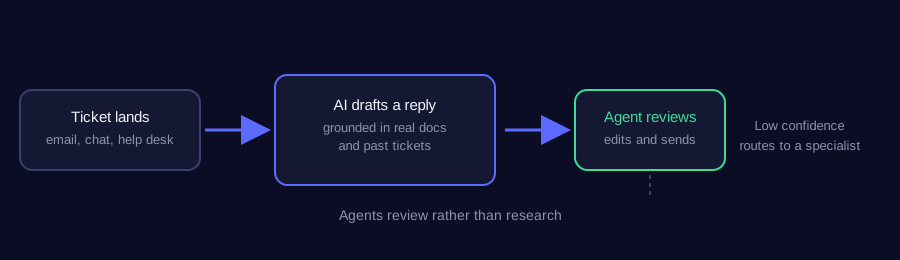
How AI-Drafted Replies Actually Reach an Agent
The moment a ticket lands, an assistant grounded in the firm’s own documentation and past resolved tickets drafts a reply with the source it pulled from attached, before an agent has even opened the ticket. The agent’s job becomes reviewing and sending, not starting from a blank reply and digging through old notes to remember the right answer.
Why Low-Confidence Cases Skip the Draft Entirely
Not every question has a clean answer sitting in the documentation. When the draft would be built on shaky ground, the system does not force one out anyway, it routes the ticket untouched to a specialist. That threshold matters more than the drafting itself: a confidently wrong AI-drafted reply would be worse than the inconsistent answers the system was built to replace.
Why Grounding in Real Documents Is the Whole Point
This only works because the assistant is grounded in the firm’s actual documentation and resolved-ticket history, not a general knowledge of the product category. Techniques like retrieval-augmented generation exist specifically to keep an AI system’s answers tied to real, current source material instead of whatever it might otherwise guess. It is the same discipline behind where AI agents genuinely belong in a business: narrow, grounded, and only where the judgement required is small enough for a rule or a source document to actually cover it.
What Changed for the Team, Not Just the Customers
The most durable change was not response time, it was onboarding. A new support hire no longer had to absorb one senior person’s memory before they could answer confidently, because the grounded draft carried that knowledge for them from day one. Answers became consistent across channels because they were coming from the same source material every time, not from whichever agent happened to pick up the ticket.
Why This Stayed a Drafting Tool, Not an Auto-Reply
Every AI-drafted reply still goes through a person before it reaches a customer, on purpose. Sending replies fully unattended would have saved a little more time, but it would also have removed the one safeguard that makes the system trustworthy: a human who actually knows the account catching the rare case where a confident-sounding draft is subtly wrong. The time saved by drafting is worth far more than the time saved by skipping review, especially early on while the source documentation is still being kept current. That review step is also what keeps the documentation itself honest: an agent noticing the same question keeps getting drafted badly is a genuinely useful signal that the underlying documentation needs updating, not just the reply.
Does this sound like your business?